Single particle
Imagine a plasticine ball of mass m landing on the floor with a thud. Suppose the ball undergoes a velocity change of Δv during the collision, which lasted for a time duration of Δt. The impact force F can thus be calculated by

Continuous stream of particles
Now imagine a heavy storm during which raindrops land on the floor at velocity v. Since there is a continuous stream of raindrops, a constant impact force F on the floor is produced. If 

This formula is useful for calculating forces related to fluid jets e.g. rocket fuel being ejected from the rocket, waterjet hitting a wall, etc.
–
Rocket Example
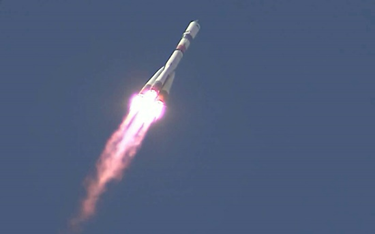
A rocket ejects propellant at the rate of 300 kg s-1 at the speed of 2000 m s-1 (relative to the rocket). Calculate the thrust developed by the rocket at the instant when the rocket lifts off.
Solution

When 300 kg of 0 m s−1 propellant becomes 300 kg of 2000 m s-1 propellant, we are looking at a momentum gain of

This “production” of momentum requires a force. According to N2L, the rate of production of momentum is the force!

Alternatively, we can use the formula 

Technically, this 600 kN is the (downward) force that the rocket must exert to expel the propellant at this rate and speed. By N3L, this is also the magnitude of the (upward) thrust force experienced by the rocket.
Water Jet Example
A high-pressure water jet ejects a cylindrical column of water with cross sectional area of 2.5 cm2 travelling at 80 m s-1. The water hits a vertical wall horizontally, loses all its horizontal velocity and trickles vertically down the wall after impact. Given that the density of the water jet is 1000 kg m-3, what is the force it exerted on the wall?

Solution

Distance travelled by water jet in 1 s

Volume of water hitting the wall in every 1 s

Mass of water hitting the wall in every 1 s

We note that in every second, 20 kg of 80 m s−1 water becomes 20 kg of 0 m s-1 water. This “destruction” of momentum requires a force. According to N2L, the rate of “destruction” of momentum is equal to the force

Technically, this 1.6 kN is the (leftward) force experience by the water jet. But by figuring out the force exerted by the wall on the water jet, we can infer the (rightward) impact force the water jet exerts on the wall. Because these two forces are an action-reaction pair.
Alternatively, we can use the formula

–
 xmPhysics