Consider a satellite of mass m in a circular orbit of radius r around the Earth. Since the orbital speed depends on the orbital radius, the KE of the satellite is also a function of r.

Needless to say, the GPE of the satellite is also a function of r.

Finally the total energy of the satellite is also a function of r.

We can now sketch the graphs of the variation of a satellite’s KE, GPE and TE with orbital radius r.
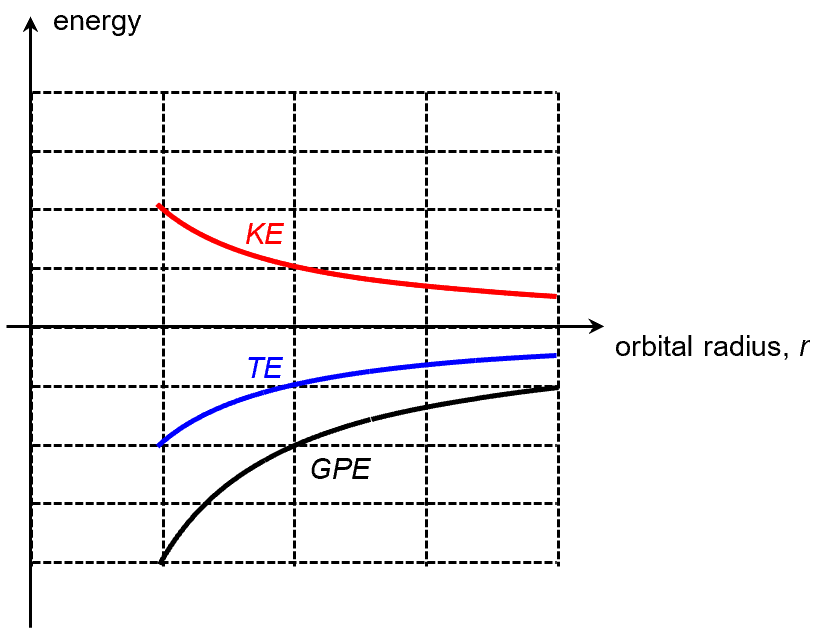
Some important points to note:
- At any r,
- TE and GPE increase with r, whereas KE decreases with r.
- To move a satellite from a lower orbit to a higher orbit, we must increase the TE of the satellite. This requires the burning of rocket fuel so that the propulsion force does (positive) work on the satellite.

–
 xmPhysics