4.3.1 Static Equilibrium

For a body to be completely motionless (i.e. neither moving nor rotating), it must be in both translational and rotational equilibrium. In other words, the net force and net moment acting on the body must both be zero.

\displaystyle \sum{F}=0

\displaystyle \sum{\tau }=0

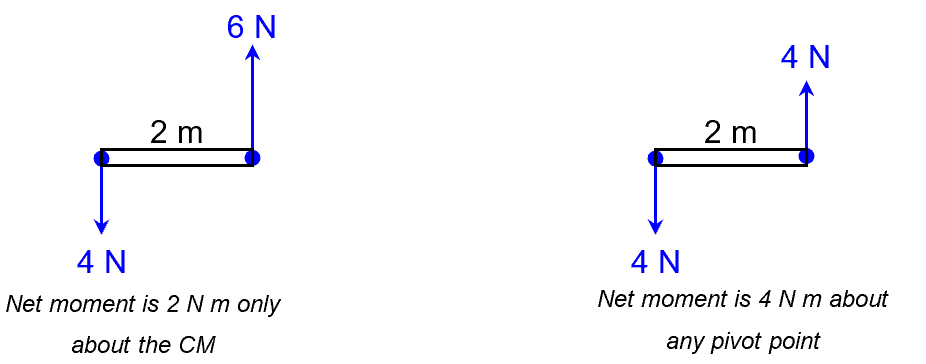
In general, \displaystyle \sum{\tau } should be evaluated using the centre of mass (CM) of the body as the pivot point. However, it turns out that if \displaystyle \sum{F}=0, then \displaystyle \sum{\tau } evaluates to be the same value about any point.

Since \displaystyle \sum{F}=0 is always true for a body in static equilibrium, it follows that \displaystyle \sum{\tau } must evaluate to be zero using any point as the pivot point.

Example

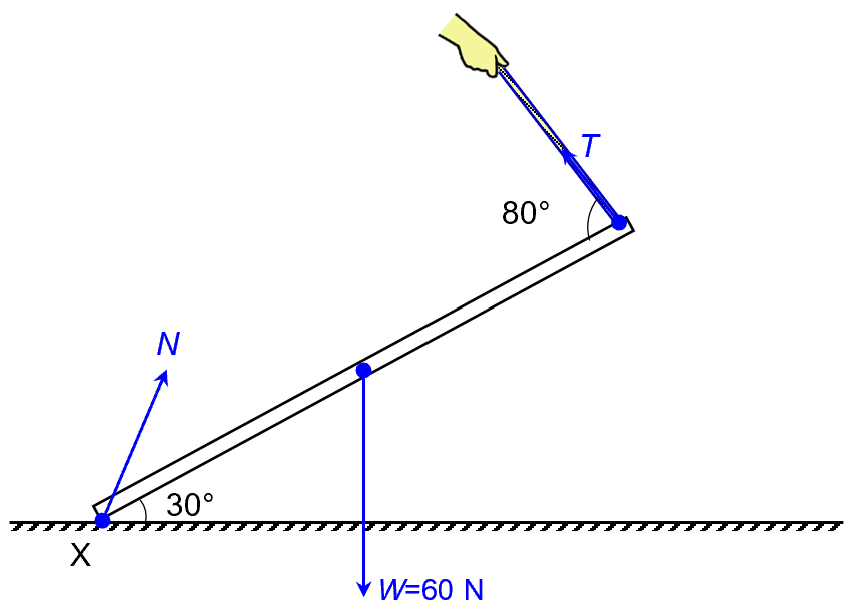
Consider a plank weighing 60 N and 7.0 m long is at rest, supported by the contact force N of the floor, and the tension force T from a rope. Determine N and T.
Solution

Take moments about X:        

\displaystyle \begin{aligned}\text{CW moment by }W&=\text{ACW moment by }T\\60\times (3.5\cos 30{}^\circ )&=(T\sin 80{}^\circ )\times 7.0\\T&=26.4\text{ N}\end{aligned}

Horizontally, ΣFx = 0:              

\displaystyle \begin{aligned}{{N}_{x}}&=T\cos 50{}^\circ \\&=(26.4)\cos 50{}^\circ \\&=16.97\text{ N}\end{aligned}

Vertically, ΣFy = 0:                  

\displaystyle \begin{aligned}{{N}_{y}}+T\sin 50{}^\circ &=W\\{{N}_{y}}+26.4\sin 50{}^\circ &=60\\{{N}_{y}}&=39.78\text{ N}\end{aligned}

Using Pythagoras:                 

\displaystyle N=\sqrt{{{{N}_{x}}^{2}+{{N}_{y}}^{2}}}=\sqrt{{{{{16.97}}^{2}}+{{{39.78}}^{2}}}}=43.2\text{ N}

USEFUL RESOURCES

Leave a comment