In this section, we will obtain the a–x and v–x equations which we can use to calculate the acceleration and velocity of a SHM at any displacement.
a-x equation
We begin by writing down the three time-domain equations.

Replacing 

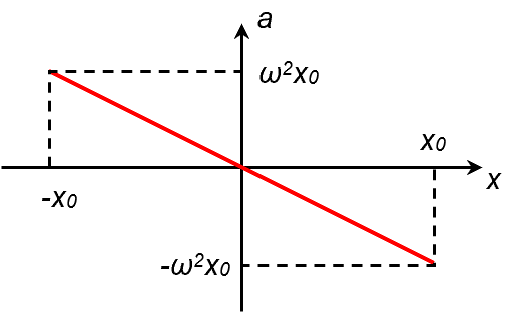
This is a very important result because it shows that the acceleration of a SHM is directly proportional in magnitude but opposite in sign to the displacement.
The a-x graph is thus a straight line passing through the origin, with the negative gradient corresponding to 
v-x equation
To obtain the v-x equation, we rewrite the x-t and v-t equations as


Using the trigonometric identity 

The v-x graph is an ellipse, with intercepts at 


You should be able to deduce that the oscillation progresses in the clockwise direction along the elliptical graph. This is because for the top half of the graph, the velocity is positive, so the displacement should progress towards the right (to become more positive). Likewise, for the bottom half of the graph, the velocity is negative, so the displacement should progress towards the left (to become more negative).
–
 xmPhysics