22P2Q01

1a)

\displaystyle \begin{aligned}  T&=2\pi \sqrt{\frac{m}{k}} \\  7.2\div 10&=2\pi \sqrt{\frac{0.120}{k}} \\  k&=9.1385\text{ N }{{\text{m}}^{-1}}  \end{aligned}

\displaystyle \begin{aligned} {{T}^{2}}&=4{{\pi }^{2}}\frac{m}{k} \\   \frac{\Delta k}{k}&=\frac{\Delta m}{m}+2\frac{\Delta T}{T} \\  &=1\%+2(\frac{0.2}{7.2}) \\&=1\%+5.556\% \\&=6.556\%  \end{aligned}

\displaystyle \Delta k=6.556\%\times 9.1385=0.5991\text{ N }{{\text{m}}^{-1}}

\displaystyle \begin{aligned}  k&=9.1385\pm 0.5991 \\  &=9.1\pm 0.6\text{ N }{{\text{m}}^{-1}}  \end{aligned}

COMMENT: Remember to present the final answer following the “1 SF same DP” convention.

1bi)

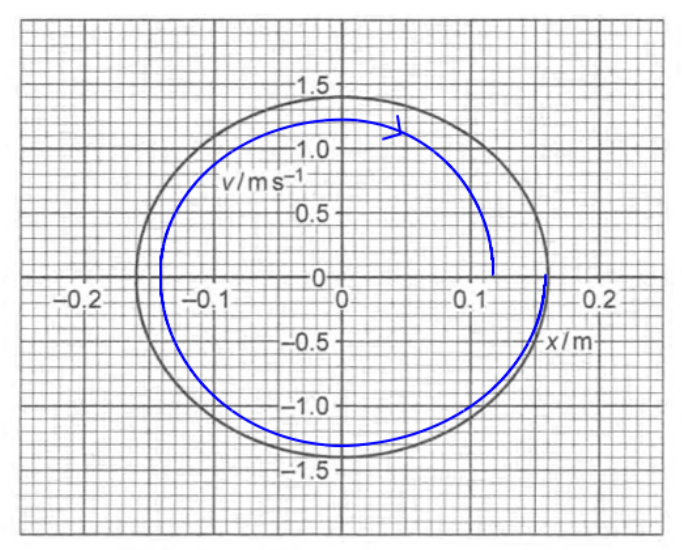
\displaystyle \begin{aligned}  ({{v}_{\max }}&=\omega {{x}_{\max }}) \\ 1.4&=\omega (0.16) \\ \omega &=8.75\text{ rad }{{\text{s}}^{-1}} \end{aligned}

\displaystyle \begin{aligned}  ({{a}_{\max }}&={{\omega }^{2}}{{x}_{\max }}) \\ {{a}_{\max }}&={{8.75}^{2}}(0.16) \\ &=12.3\text{ m }{{\text{s}}^{-2}} \end{aligned}

1bii)

COMMENT: Your spiral must start from (0.16, 0.00). This is because the question stated that the motion starts from maximum displacement and zero velocity.

Leave a comment