9a)
The energy E contained in each photon is proportional to the frequency of radiation f. (
A photoelectron is liberated when one electron absorbs the energy of one photon, and the maximum KE is given by

Photon theory can explain observation 1 because increasing the intensity merely increases the number of photons arriving per unit time, but the energy of each individual photon is unchanged. Wave theory predicts that increasing the intensity should emit photoelectrons of higher KE.
Photon theory can explain observation 2 because if the frequency is so low that the photon energy is less than the work function, every photon does not contain enough energy to liberate any single photoelectron. Wave theory predicts that given enough time, photoelectrons will be emitted.
COMMENT: This is a lot to write for four marks. Yes I agree.
9b)
Threshold frequency.
9c)

9d)

9ei)
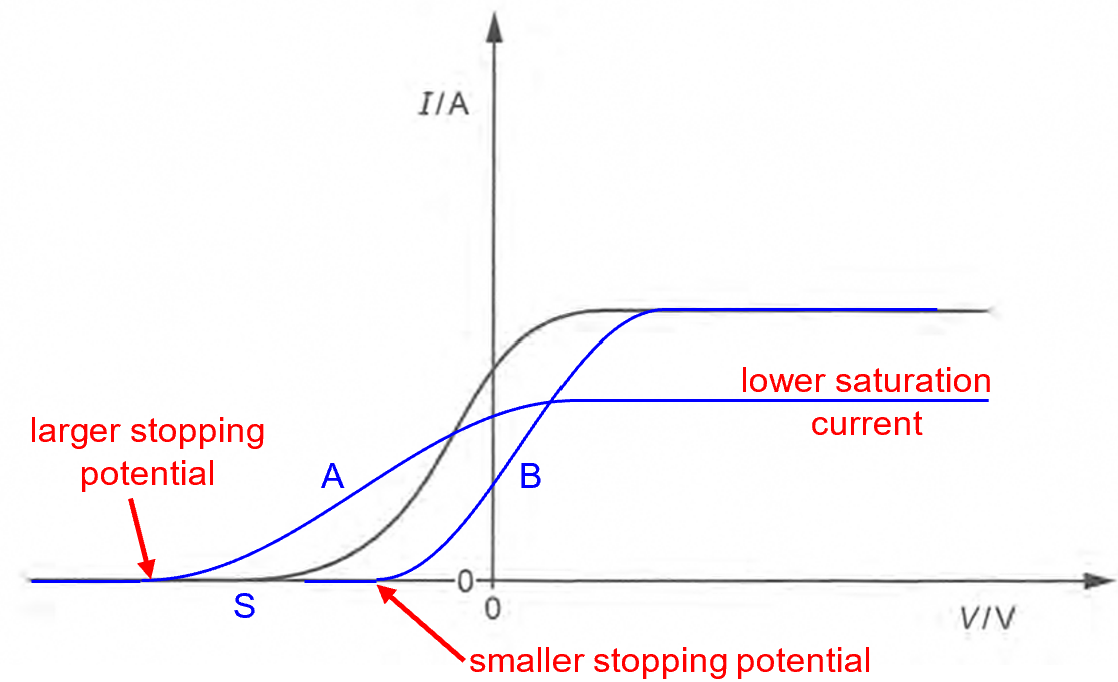
9eii)
The graph drawn should have a larger stopping potential but lower saturation current.
COMMENT: The saturation current is lower because we assumed that the yield remains the same. In real life, this is probably a bad assumption.
COMMENT: We are also assuming that “same intensity” means the same amount light energy arriving (per unit time per unit area) instead of the same number of photons arriving (per unit time per unit area). So if two beams of light have the intensity, then the beam with the higher frequency of radiation must have less photon (per unit time per unit area) since the energy is delivered in larger packets. With less photons (per unit time per unit area), and assuming that the yield rate is the same, is how we end up with a lower saturation current.
9eiii)
The graph drawn should have a lower stopping potential but same saturation current.
COMMENT: Again, the saturation current is unchanged because we assumed that the yield remains the same. In real life, this is probably a bad assumption.
9eiv)
V sets up a potential barrier between the electrode and the zinc plate.
If V is larger or equal to the stopping potential, then even the photoelectrons with the maximum KE are not able to overcome the potential barrier to arrive at the zinc plate, hence no current.
9fi)


9fii)
The longest wavelength corresponds to the smallest energy transition, which is between the -0.4 eV and -1.1 eV energy line.

 xmPhysics