Question:
Answer:
Why the reading increases as the bob enters the water?
When the bob is entering the water, it displaces more and more water. The water thus exerts a larger and larger upthrust on the bob. By Newton’s 3rd Law, the bob exerts a larger and larger “downthrust” on the water (and beaker). Since the density of water is about 1 g cm-3, every 1 cm3 displacement of water means an additional upthrust of 1 gram times 9.81 ms-2, resulting in a 1 gram increase in the weighing balance reading.
Why the reading stops increasing when the bob is fully submerged?
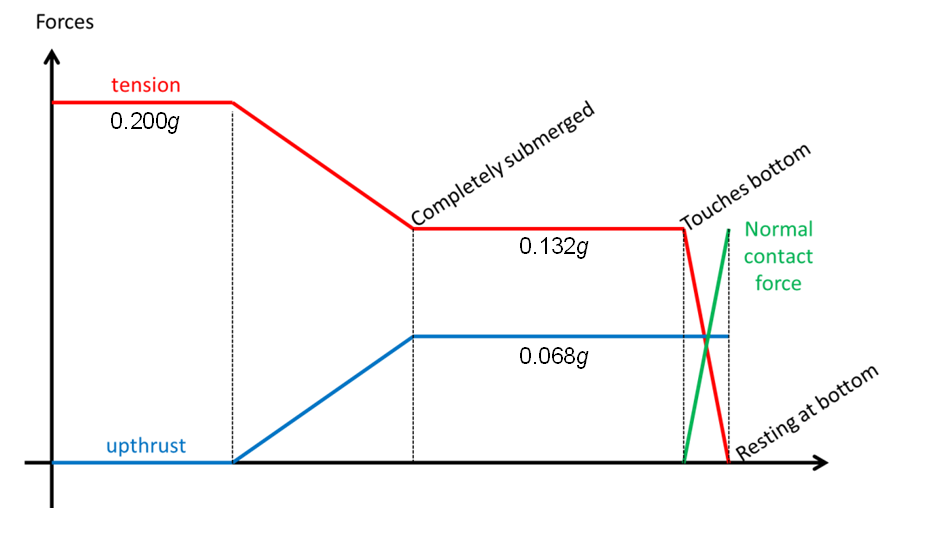
Once the bob is fully submerged, it displaces about 68 cm-3 of water. Lowering it further does not lead to any increase in upthrust, since the amount of water displaced does not increase further (even though the pressure around the bob keeps increasing. (Why?). The weighing balance reading remains constant at 68 g, corresponding to the mass of 68 cm-3 of displaced water.
Why the reading increases again when the bob lands?
When the bob touched the bottom of the measuring cylinder, it begins to exert a downward contact force on the cylinder. (And the tension in the string starts to weaken). This is reflected by the increase in the weighing balance reading.
When the bob has fully landed, the string is slack so tension has dropped completely to zero. The entire weight of the 200 g bob is now fully supported by upthrust and contact force, as reflected in the weighing balance reading of 200 g.
The graph below shows how the forces of tension, upthrust and the normal contact force (that the beaker exerts on the bob) vary as the bob was lowered. (Note that the reading on the weighing balance corresponded to the upthrust and normal contact force.)
 xmPhysics