6a)
Similarity: Both refer to energy converted per unit charge, measured in volts.
Difference: Whie e.m.f. is about conversion from non-electrical to electrical forms by a battery, p.d. is about conversion from electrical to non-electrical forms in the external circuit.
6bi)
The voltmeter is not measuring the e.m.f. but the terminal p.d. of the battery.
Since a current is flowing, there is p.d. across the internal resistance of the battery, making the terminal p.d. smaller than the e.m.f.
6bii)
Total resistance

P.d. across the 10 Ω

6ci)
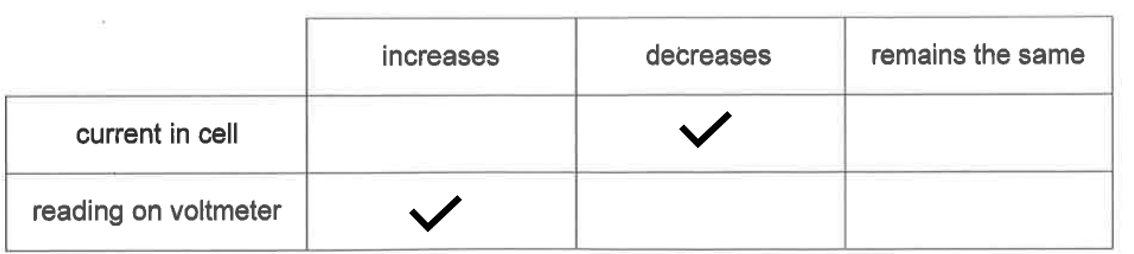
6cii)
First, solve for the internal resistance of battery r.

Effective resistance across the 10 Ω

By P.D.P., p.d. across the 10 Ω

 xmPhysics
One thought on “24P3Q06”