Author: mrchuakh

24P3Q04

4a)

The centre of gravity of an object is the point at which the entire weight of the object appears to act.

4b)

Take moments about hinge:

Fig. 4.1:           \displaystyle W\times x=12\times 3.0\quad \cdots \cdots (1)

Fig. 4.2:           \displaystyle W\times (3.0-x)=16\times 3.0\quad \cdots \cdots (2)

(1)+(2):            \displaystyle \begin{aligned}W\times x=28\times 3.0 W&=28\text{ N}\end{aligned}

Sub. Into (1):   \displaystyle \begin{aligned}28\times x&=12\times 3.0 x&=1.29\text{ m}\end{aligned}

4c)

Same.

The perpendicular distances of W and F are now both shorter by the same factor of cos30°.

The ratio of the perpendicular distances is thus unchanged.

24P3Q02

2a)

Gravitational pull provides required centripetal force.

\displaystyle \frac{GMm}{{{(R+h)}^{2}}}=m\frac{{{v}^{2}}}{(R+h)}\text{ }\Rightarrow \text{ }v=\sqrt{\frac{GM}{R+h}}

\displaystyle {{E}_{k}}=\frac{1}{2}m{{v}^{2}}=\frac{1}{2}m{{\left( \sqrt{\frac{GM}{R+h}} \right)}^{2}}=\frac{GMm}{2(R+h)}

2b)

\displaystyle \begin{aligned}   {{E}_{T}}=KE+GPE &=\frac{1}{2}\frac{GMm}{(R+h)}+(-\frac{GMm}{R+h}) &=-\frac{1}{2}\frac{GMm}{R+h}\end{aligned}

2c)

Gravitational pull provides required centripetal force.

\displaystyle \frac{GMm}{{{(R+h)}^{2}}}=m\frac{{{v}^{2}}}{(R+h)}\text{ }\Rightarrow \text{ }v=\sqrt{\frac{GM}{R+h}}

\displaystyle \begin{aligned}v&=\sqrt{\frac{GM}{R+h}} &=\sqrt{\frac{(6.67\times {{10}^{-11}})(7.35\times {{10}^{22}})}{1.74\times {{10}^{6}}+110000}} &=1620\text{ m }{{\text{s}}^{-1}}\end{aligned}

2di)

P has higher Ek.

Since \displaystyle {{E}_{k}}=\frac{GMm}{2(R+h)}, Ek is higher when h is smaller.

This is because at lower altitude, the satellite must orbit faster in order for the centripetal acceleration to match the stronger gravitational acceleration.

2dii)

P has lower ET.

Since \displaystyle {{E}_{T}}=-\frac{GMm}{R+h}, ET is more negative when h is smaller.

This is because the GPE is more negative at lower altitude.

24P2Q03

3ai)

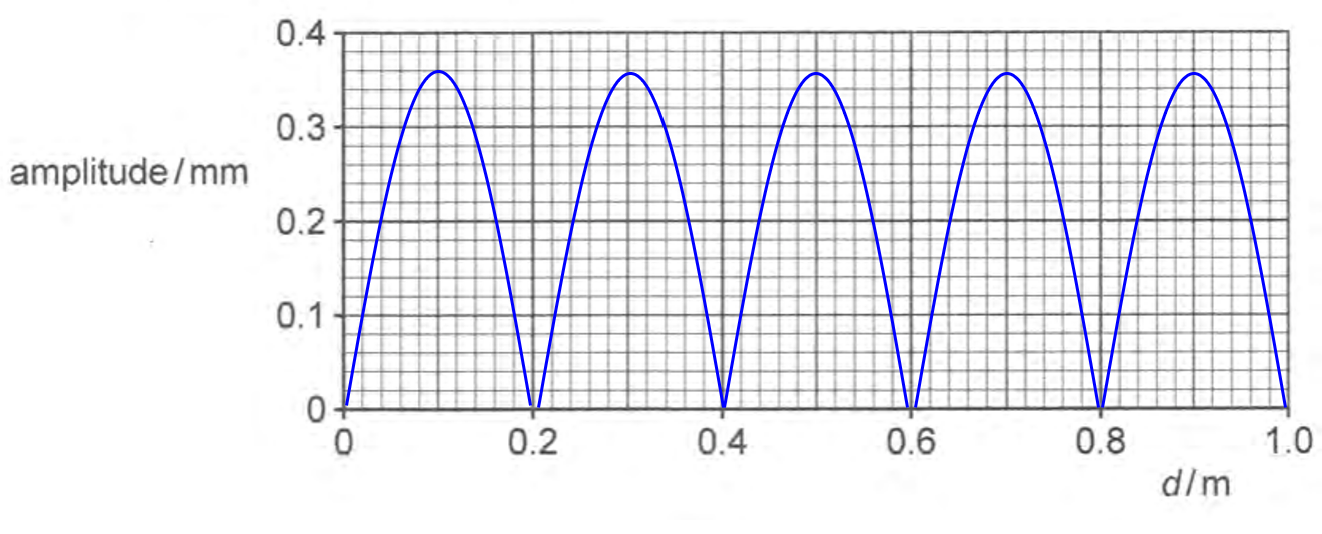
This is so that the sound waves emitted by X and Y are coherent.

3aii)

Connect a small microphone to a CRO.

Move the microphone along the straight line between X and Y and observe the amplitude of the sound wave on the CRO.

Use a ruler to measure the distance L between two consecutive maximum amplitude.

Wavelength is equal to 2L.$$

3bi)

\displaystyle \begin{aligned}v&=f\lambda  \\340&=f(0.40) \\f&=850\text{ Hz}  \end{aligned}

3bii)

24P2Q07

7a)

KE of a photoelectron is equal to the energy of photon minus the work required to break free from the lattice attraction.

Even though the energy of each photon is the same, the electrons are bound to different degree to the metal lattice.

The liberated photoelectrons hence have a range of KE, with the maximum value belonging to the least tightly bound electron, which is equal to energy of photon minus the work function..

7b)

\displaystyle \begin{aligned}K{{E}_{\max }}&=hf-\Phi  \\3.48e&=3.95e-\Phi  \\\Phi &=4.47\text{ eV}  \end{aligned}
.

\displaystyle \begin{aligned}\Phi &=\frac{hc}{{{\lambda }_{\max }}} \\4.47e&=\frac{(6.63\times {{10}^{-34}})(3.00\times {{10}^{8}})}{{{\lambda }_{\max }}} \\{{\lambda }_{\max }}&=2.78\times {{10}^{-7}}\text{ m}  \end{aligned}

7c)

The number of photoelectrons per unit time hitting metal plate is now higher.

This should lead to more photoelectrons being ejected per unit time.

Time taken to fully discharge is shorter.

7d)

Infrared’s wavelength is too long.

The energy of each photon is lower than the work function.

This means each photon does not contain sufficient energy to liberate even the least tightly bound electron.

24P2Q01

1a)

\displaystyle \begin{aligned}\text{gain in GPE}&=mg\Delta h \\27&=(0.43)(9.81)\Delta h \\\Delta h&=6.40\text{ m}\end{aligned}

1b)

\displaystyle \begin{aligned}({{v}^{2}}&={{u}^{2}}+2as) \\0&={{u}_{y}}^{2}+2(-9.81)(6.40) \\{{u}_{y}}&=11\text{ m }{{\text{s}}^{-1}}  \end{aligned}

1ci)

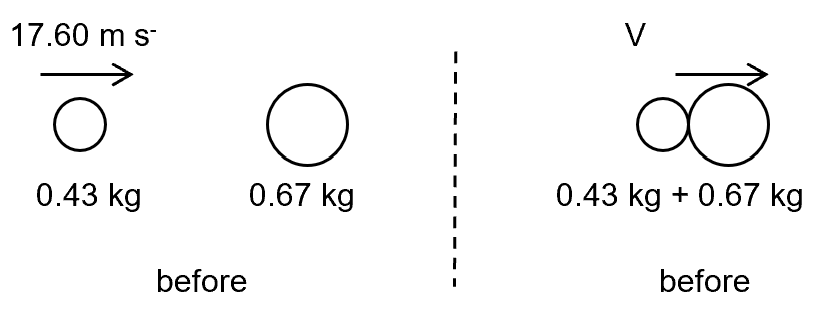
\displaystyle \begin{aligned}{{u}_{y}}&=11 \\u\sin 32{}^\circ &=11\text{ } \\u&=20.76\text{ m }{{\text{s}}^{-1}}  \end{aligned}

\displaystyle \begin{aligned}{{u}_{x}}&=u\cos 32{}^\circ  \\&=20.76\cos 32{}^\circ  \\&=17.60\text{ m }{{\text{s}}^{-1}}  \end{aligned}

By PCOM:
\displaystyle \begin{aligned}(0.43)(17.60)+0&=(0.43+0.67)V \\V&=6.88\text{ m }{{\text{s}}^{-1}}\end{aligned}

1cii)

The horizontal component of velocity as it rises is higher than when it falls.

Since the vertical height is the same, the time taken to rise and fall are the same.

Hence, the horizontal distance is higher as it rises.

24P2Q08

8a)

87.7 years is >6 times the lifespan of Perseverance.

The RTG can provide a fairly constant power over the lifespan of Perseverance.

8b)

The penetrating power of α-particles is very low. It is much easier to provide shielding so that the other devices in Perseverance are not damaged by the radiation.

8c)

α-particles are highly ionising and can cause biological damage through direct and indirect effects.

8di)

\displaystyle _{94}^{238}Pu\to _{92}^{234}U+_{2}^{4}\alpha

8dii)

Increase in total BE
\displaystyle \begin{aligned}&=(234\times 7.601+4\times 7.074)-238(7.568) \\&=1806.93-1801.184 \\&=5.746\text{ MeV}\div 1.60\times {{10}^{-19}}\div {{10}^{6}} \\&=9.19\times {{10}^{-13}}\text{ J}  \end{aligned}

8diii)

\displaystyle n{{N}_{A}}=\frac{4.9}{276\times {{10}^{-3}}}\times (6.02\times {{10}^{23}})=1.07\times {{10}^{25}}

8div)

\displaystyle \begin{aligned}A&=\lambda N \\&=\frac{\ln 2}{87.7\times 365\times 24\times 3600}(1.07\times {{10}^{25}}) \\&=2.682\times {{10}^{15}}\text{ Bq}  \end{aligned}

\displaystyle \begin{aligned}P&=(2.682\times {{10}^{15}})\times 9.19\times {{10}^{-13}} \\&=2460\text{ W}  \end{aligned}

8v)

\displaystyle _{94}^{238}Pu\to _{82}^{206}Pb+a_{2}^{4}\alpha +b_{-1}^{0}\beta

\displaystyle a=\frac{238-206}{4}=8

\displaystyle 94=82+8\times 2-b\text{ }\Rightarrow \text{ }b=4

\displaystyle _{94}^{238}Pu\to _{82}^{206}Pb+8_{2}^{4}\alpha +4_{-1}^{0}\beta

8 alpha decays and 4 beta decays.

8ei)

A decrease which decreases by a fixed percentage for the same duration of time.

8eii)

Method 1

\displaystyle \begin{aligned}P&={{P}_{o}}{{(100\%-0.79\%)}^{14}}\\&=110{{(0.9921)}^{14}} \\&=98.4\text{ W}  \end{aligned}

Method 2

\displaystyle \begin{aligned}P&={{P}_{0}}{{(\frac{1}{2})}^{\frac{14}{87.7}}} \\&=110{{(\frac{1}{2})}^{\frac{14}{87.7}}} \\&=98.5\text{ W}  \end{aligned}

8f)

\displaystyle \begin{aligned}e.m.f.&=\Delta S\Delta T \\&=(240-(-200))\times {{10}^{-6}}(1273-573) \\&=0.308\text{ V}  \end{aligned}

8g)

\displaystyle \begin{aligned}g&=\frac{GM}{{{R}^{2}}} \\\frac{{{g}_{E}}}{{{g}_{M}}}&=\frac{{{M}_{E}}}{{{M}_{M}}}\div {{(\frac{{{R}_{E}}}{{{R}_{M}}})}^{2}} \\\frac{9.81}{{{g}_{M}}}&=9.30\div {{1.88}^{2}} \\{{g}_{M}}&=3.73\text{ N k}{{\text{g}}^{-1}}  \end{aligned}

8hi)

The RTG can store the energy in some rechargeable batteries, which in turn provide the power for MOXIE.

8hii)

The operation lasts 12400 s.

Energy needed by MOXIE\displaystyle =Pt=300\times 12400=3.72\text{ MJ}

Time taken for RTG to store this amount of energy \displaystyle =\frac{3.72\times {{10}^{6}}}{110}=33818\text{ s}\div 3600=9.39\text{ hrs}

8hiii)

\displaystyle \begin{aligned}pV&=nRT \\(610)V&=\frac{5.37}{32}(8.31)(273.15-60) \\V&=0.487\text{ }{{\text{m}}^{3}}  \end{aligned}

24P2Q05

5a)

\displaystyle \begin{aligned}B&={{\mu }_{o}}\frac{\mathrm{I}}{2\pi r} \\   2.8\times {{10}^{-4}}&=(4\pi \times {{10}^{-7}})\frac{\mathrm{I}}{2\pi (8.5\times {{10}^{-3}})} \\  \mathrm{I}&=11.9\text{ A} \end{aligned}

5bi)

\displaystyle \begin{aligned}F&=BIL \\\frac{F}{L}&=BI \\&=(2.8\times {{10}^{-4}})(9.2) \\&=2.58\times {{10}^{-3}}\text{ N }{{\text{m}}^{-1}}  \end{aligned}

5bii)

Weight per unit length\displaystyle =0.063\times 9.81=0.61803\text{ N }{{\text{m}}^{-1}}

Percentage change\displaystyle =\frac{2.58\times {{10}^{-3}}}{0.61803}=0.417%

5biii)

Decrease.

Unlike currents repel. The magnetic force exerted on rod is upward and helps support the weight.

5biv1)

The magnetic field of the wire above the wire is directed out of the page.

The current is upward.

Using Fleming’s Left Hand Rule, the magnetic force on the wire is rightward.

5biv2)

It is inversely proportional to the distance.

COMMENT: This is because the magnetic flux density is inversely proportional to distance.\displaystyle B={{\mu }_{o}}\frac{\mathrm{I}}{2\pi r}

24P2Q06

6a)

Most α-particles pass straight through, implying most of the atom is empty space.

All the mass and charges are concentrated in a tiny volume in the centre, called the nucleus.

This is the only way to explain how those α-particles that pass near the nucleus can experience such strong electrical repulsion that they are turned back by the nucleus.

6b)

\displaystyle \begin{aligned}\text{initial KE + EPE}&=\text{final KE+EPE} \\1.23\times {{10}^{-12}}+0&=0+(8.99\times {{10}^{9}})\frac{(2e)(79e)}{d} \\d&=2.96\times {{10}^{-14}}\text{ m}  \end{aligned}

24P2Q02

2a)

There is negligible intermolecular forces except during collisions.

2b)

The summation of microscopic kinetic energy due to random motion of the molecules.

COMMENT: For an ideal gas, there is no microscopic potential energy.

2ci)

\displaystyle \begin{aligned}KE&=U \\&=\frac{3}{2}NkT \\&=\frac{3}{2}(2.50\times {{10}^{23}})(1.38\times {{10}^{-23}})(273.15+21) \\&=1520\,J  \end{aligned}

2cii)

\displaystyle \begin{aligned}\Delta U&=\frac{3}{2}Nk\Delta T \\&=\frac{3}{2}(2.50\times {{10}^{23}})(1.38\times {{10}^{-23}})(15) \\&=77.625\text{ J}  \end{aligned}
.

\displaystyle \begin{aligned}{{W}_{on}}&=-p\Delta V \\&=-(1.0\times {{10}^{5}})(+6.3\times {{10}^{-4}}) \\&=-63\text{ J}  \end{aligned}
.

\displaystyle \begin{aligned}\Delta U&=Q+{{W}_{on}} \\77.625&=Q+(-63) \\Q&=141\,\text{J}  \end{aligned}