Author: mrchuakh

23P3Q03

3a)

(Net) Rate of flow of electric charges.

3b)

Volume of the conductor\displaystyle =Al

Number of charges in the conductor \displaystyle =n(Al)

Amount of charges in the conductor \displaystyle \Delta Q=n(Al)q

Time taken for these charges to flow out of the conductor\displaystyle \Delta t=l\div v

Current \displaystyle  I=\frac{\Delta Q}{\Delta t}=\frac{nAlq}{l\div v}=nAvq

3ci)

\displaystyle \begin{aligned}  I&=nAvq \\ 2.00&=\frac{1.45\times {{10}^{23}}}{A(3.00)}Av(1.60\times {{10}^{-19}}) \\ v&=2.59\times {{10}^{-4}}\text{ m }{{\text{s}}^{-1}} \end{aligned}

3cii)

At any one time, the electrons are travelling at high speed in different directions.

The drift velocity is average velocity of all the electrons in one direction along the wire.

OR

As the electrons move along the wire, they keep changing direction as they collide with the metal lattice again and again.

Even though the total distance travelled is very large (hence high speed), the net displacement is very small (hence low velocity).

23P3Q01

1a)

\displaystyle x=\frac{{{L}^{3}}gM}{4w{{t}^{3}}E}

Units of x \displaystyle =\text{m}

\displaystyle  \begin{aligned} \text{Units of }\frac{{{L}^{3}}gM}{4w{{t}^{3}}E}   & =\frac{\text{(}{{\text{m}}^{3}}\text{)(m }{{\text{s}}^{-2}}\text{)(kg)}}{\text{(m)(}{{\text{m}}^{3}})(\text{N }{{\text{m}}^{-2}})} \\ & =\frac{{{\text{s}}^{-2}}\text{.kg}}{\text{(kg m }{{\text{s}}^{-2}})({{\text{m}}^{-2}})} \\ & =\text{m} \end{aligned}

1b)

\displaystyle  \begin{aligned} E&=\frac{{{L}^{3}}gM}{4w{{t}^{3}}x} \\ & =\frac{{{(0.800)}^{3}}(9.81)(300\times {{10}^{-3}})}{4(2.10\times {{10}^{-2}}){{(4.56\times {10}^{-3})}^{3}}(1.00\times {{10}^{-2}})} \\ &=1.8918\times {{10}^{10}}\text{ Pa} \end{aligned}

\displaystyle  \begin{aligned} \frac{\Delta E}{E} &=3\frac{\Delta L}{L}+\frac{\Delta g}{g}+\frac{\Delta M}{M}+\frac{\Delta w}{w}+3\frac{\Delta t}{t}+\frac{\Delta x}{x} \\ &=3\frac{0.005}{0.800}+\frac{0.01}{9.81}+\frac{2}{300}+\frac{0.02}{2.10}+3\frac{0.01}{4.56}+\frac{0.01}{1.00} \\ &=5.2539\% \end{aligned}

\displaystyle E=1.89\times {{10}^{10}}\text{ Pa }\pm 5\%

COMMENT: This question is rather unusual, in the sense that . In all the past year questions, the requirement was to present the final answer using the “1 s.f. matching d.p.” rule. And the answer would have been as follow:

\displaystyle \begin{aligned} \Delta E&=0.052539\times 1.8918\times {{10}^{10}} \\ & =9.940\times {{10}^{8}} \\ & =1\times {{10}^{9}}\text{ (1 sf)} \end{aligned}

\displaystyle E=(1.9\pm 0.1)\times {{10}^{10}}

COMMENT: It is debatable whether the uncertainty for g should be incorporated. Since we are using 9.81 m s-2 as the value for g, one may argue that g has a small percentage uncertainty of about \displaystyle \frac{\Delta g}{g}=\frac{0.01}{9.81}=0.102\%. However, regardless, it does not affect our final answer.
23P2Q08

8a)

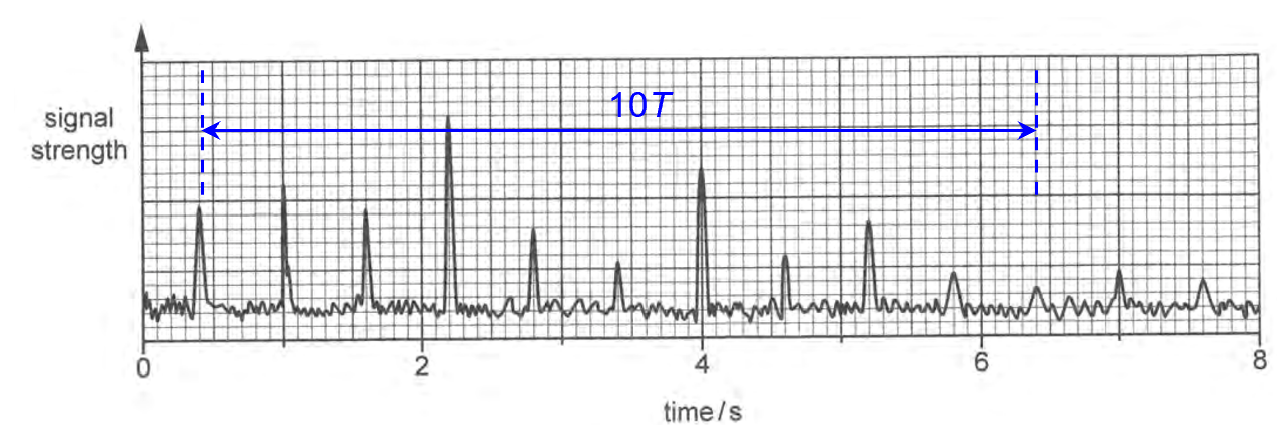
\displaystyle  T=\frac{6.0}{10}=0.60\text{ s}

\displaystyle  \omega =\frac{2\pi }{T}=\frac{2\pi }{0.60}=10.5\text{ rad }{{\text{s}}^{-1}}

8b)

The pulsar and the parent star must have the same angular momentum.

Since the pulsar has a much smaller radius, it must have a much larger angular velocity.

8c)

Binding energy per nucleon peaks near iron-56.

The fusion of iron to form even larger nuclei requires energy input (instead of releases energy).

8di)

\displaystyle  \begin{aligned}   g&=\frac{GM}{{{R}^{2}}} \\  &=\frac{(6.67\times {{10}^{-11}})(1.4\times 2.0\times {{10}^{30}})}{{{10000}^{2}}} \\  &=1.87\times {{10}^{12}}\text{ N k}{{\text{g}}^{-1}} \end{aligned}

8dii)

\displaystyle  \begin{aligned}  \Delta g&=GM(\frac{1}{{{r}_{1}}^{2}}-\frac{1}{{{r}_{2}}^{2}}) \\ & =(6.67\times {{10}^{-11}})(1.4\times 2.0\times {{10}^{30}})(\frac{1}{{{10000}^{2}}}-\frac{1}{{{10001}^{2}}}) \ & =(6.67\times {{10}^{-11}})(1.4\times 2.0\times {{10}^{30}})(1.9997\times {{10}^{-12}}) \\ & =3.73\times {{10}^{8}}\text{ N k}{{\text{g}}^{-1}} \end{aligned}

8diii)

It becomes longer than 3.0 m.

The difference in gravitational force across the two ends of the rod is so large that the intermolecular forces of the rod is not able to keep the entire rod accelerating at the same rate.

8ei)

\displaystyle  \begin{aligned}   v&=r\omega  \\ & =(100000)(\frac{2\pi }{2.0\times {{10}^{-3}}}) \\ & =3.14\times {{10}^{8}}\text{ m }{{\text{s}}^{-1}} \\ & >c \end{aligned}

The speed of the surface cannot exceed the speed of light.

8eii)

The pulsar disintegrates if, at a point on the surface of the pulsar, the gravitational acceleration is equal to the centripetal acceleration.

\displaystyle  \begin{aligned}   \frac{GM}{{{r}^{2}}}&=r{{\omega }^{2}} \\  \frac{G(\frac{4}{3}\pi {{r}^{3}}\rho )}{{{r}^{2}}}&=r{{(\frac{2\pi }{T})}^{2}} \\  \rho &=\frac{3\pi }{G{{T}^{2}}} \end{aligned}

8eiii)

\displaystyle  \rho =\frac{3\pi }{G{{T}^{2}}}=\frac{3\pi }{(6.67\times {{10}^{-11}}){{(0.60)}^{2}}}=3.93\times {{10}^{11}}\text{ kg }{{\text{m}}^{-3}}

8f)

\displaystyle  \text{age}=\frac{T}{2\Delta T}=\frac{33.5\times {{10}^{-3}}}{2[(38\times {{10}^{-9}})\div (24\times 60\times 60)]}=3.808\times {{10}^{10}}\text{ s}=1210\text{ years}

8g)

\displaystyle  \begin{aligned}  {{E}_{photon}}&=\frac{hc}{\lambda } \\  (400\times {{10}^{12}})(1.60\times {{10}^{-19}})&=\frac{(6.63\times {{10}^{-34}})(3.00\times {{10}^{8}})}{\lambda } \\  \lambda &=3.11\times {{10}^{-21}}\text{ m} \end{aligned}

8h)

With a larger collecting area, the SKA can collect a larger power for the same intensity of radio signals, allowing it to detect lower intensity pulsars.

23P2Q07

7ai)

Photoelectric effect

7aii)

Double slit interference pattern

7bi)

+ on the left, – on the right.

7bii)

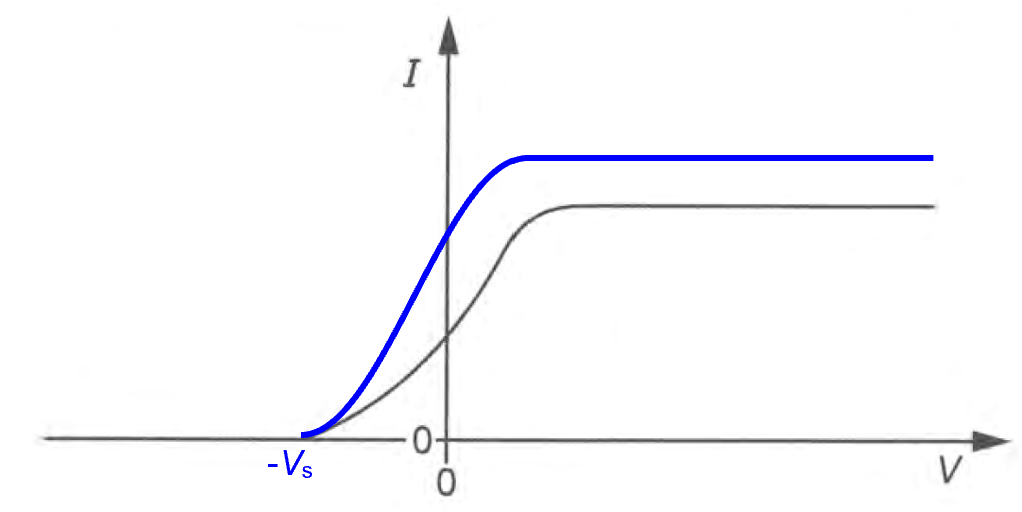
\displaystyle  \begin{aligned}   K{{E}_{\max }}&=hf-\Phi  \\  e{{V}_{s}}&=12.4e-4.2e \\  {{V}_{s}}&=8.2\text{ V} \end{aligned}

7biii)

Increasing the intensity only increases the number of photons per unit time.

The energy of each individual photon remains at 12.4 eV.

Since each photoelectron is liberated by the energy of one photon, its KEmax is not increased.

7c)

23P2Q06

6a)

The total induced emf is directly proportional to the rate of change of flux

linkage (for a coil), or rate of cutting of flux (for a moving wire).

6b)

As the wire oscillates, it cuts the magnetic flux. Hence emf is induced between the two ends of the wire.

Since the wire cuts the magnetic flux in opposite directions on the way up and down, the induced emf also alternates in direction.

6c)

\displaystyle  \begin{aligned}   (\varepsilon &=BLv) \\  \varepsilon &=(0.250)(0.15)(0.80) \\  &=0.030\text{ V} \end{aligned}

COMMENT: The substitution value for L should be 15 cm instead of 35 cm. Because there is magnetic field only along the 15 cm wide poles, the other 20 cm of the wire is not cutting any magnetic flux.

6d)

The e.m.f. between X and the folded end is 0.030 V.

The e.m.f. between Y and the folded end is also 0.030 V, with the same polarity.

The e.m.f. between X and Y is thus zero.

23P2Q05

5a)

The graph starts off as a straight line passing through the origin, and then becomes a steepening curve.

Since resistance is the voltage to current ratio, the graph is showing that resistance of the thermistor is constant at low V values, but decreases with V when V is large.

5bi)

The current through both resistors are the same.

\displaystyle  \frac{{{P}_{220}}}{{{P}_{640}}}=\frac{{{I}^{2}}{{R}_{220}}}{{{I}^{2}}{{R}_{640}}}=\frac{220}{640}=0.34

5bii)

No effect.

While the current drawn from the supply is now lower, both resistors still carry the same current.

The ratio in (b)(i) depends only on the ratio of the resistances.

5biii)

Total resistance in series:       \displaystyle  {{R}_{s}}=220+640=860\text{  }\Omega \text{ }

Total resistance in parallel:     \displaystyle  {{R}_{p}}={{(\frac{1}{220}+\frac{1}{640})}^{-1}}=163.7\text{  }\Omega\text{ }

\displaystyle  \frac{{{I}_{s}}}{{{I}_{p}}}=\frac{\varepsilon }{{{R}_{s}}}\div \frac{\varepsilon }{{{R}_{p}}}=\frac{{{R}_{p}}}{{{R}_{s}}}=\frac{163.7}{860}=0.190

5biv)

No effect.

Since both the series and parallel circuits are connected to the same a.c. power supply with the same peak voltages, the ratio of the peak (or rms) currents depends only on ratio of the resistances.

23P2Q04

4a)

The incident sound wave reflects off the metal plate.

The incident and reflected sound waves, being sound waves of the same frequency travelling in opposite directions, superpose to form a stationary wave.

4aii)

One complete cycle has a width of 5 cm on the oscilloscope.

Period \displaystyle  T=5\times 0.50=2.5\text{ ms}

Frequency \displaystyle  f=\frac{1}{T}=\frac{1}{2.5\times {{10}^{-3}}}=400\text{ Hz}

4aiii)

\displaystyle  \begin{aligned} (v&=f\lambda ) \\340&=(400)\lambda  \\  \lambda &=0.85\text{ m}  \end{aligned}

Distance between adjacent nodes\displaystyle  =\frac{\lambda }{2}=0.85\div 2=0.425\text{ m}

4bi)

Path difference\displaystyle  =YP-XP=1.8-1.4=0.4\text{ m}, which corresponds to \displaystyle  0.4\div 0.20=2\lambda .

Since path difference is an integer number of wavelengths, the two waves will meet in phase, under constructive interference and forms a maximum at P.

4bii)

\displaystyle  \begin{aligned}  (I&\propto \frac{1}{{{r}^{2}}}) \\  \frac{{{I}_{Y}}}{{{I}_{X}}}&=\frac{X{{P}^{2}}}{Y{{P}^{2}}} \\   \frac{{{I}_{Y}}}{4.5\times {{10}^{-6}}}&={{(\frac{1.4}{1.8})}^{2}} \\   {{I}_{Y}}&=2.7\times {{10}^{-6}}\text{ W }{{\text{m}}^{-2}}  \end{aligned}

4biii)

\displaystyle  I\propto {{A}^{2}}

\displaystyle  \frac{{{A}_{X}}}{{{A}_{Y}}}=\sqrt{\frac{{{I}_{X}}}{{{I}_{Y}}}}=\sqrt{{{(\frac{1.8}{1.4})}^{2}}}=\frac{1.8}{1.4}=1.29

23P2Q03

3ai)

\displaystyle  \begin{aligned}  (F&=G\frac{Mm}{{{r}^{2}}}) \\ F&=(6.67\times {{10}^{-11}})\frac{(6.0\times {{10}^{24}})(6800)}{{{[(6400+36000)\times {{10}^{3}}]}^{2}}} \\ &=1510\text{N} \end{aligned}

3aii)

\displaystyle  \begin{aligned}  G\frac{Mm}{{{r}^{2}}}&=mr{{\omega }^{2}} \\ \omega & =\sqrt{\frac{GM}{{{r}^{3}}}} \end{aligned}

Not necessary.

Both the gravitational force and the required centripetal force are directly proportional to the mass.

For the same orbital radius, all satellites orbit at the same angular velocity (and thus period), regardless of the mass of the satellite.

3bi)

The magnetic force provides the required centripetal force for circular motion.

\displaystyle  \begin{aligned}   Bqv&=m\frac{{{v}^{2}}}{r} \\  Bqr&=p \\  (1.8\times {{10}^{-3}})(1.60\times {{10}^{-19}})r&=(3.4\times {{10}^{-23}}) \\  r&=0.118\text{ m} \end{aligned}

3bii)

No.

If the ion has a different mass, it has a different momentum but experience the same magnetic force.

23P2Q02

2a)

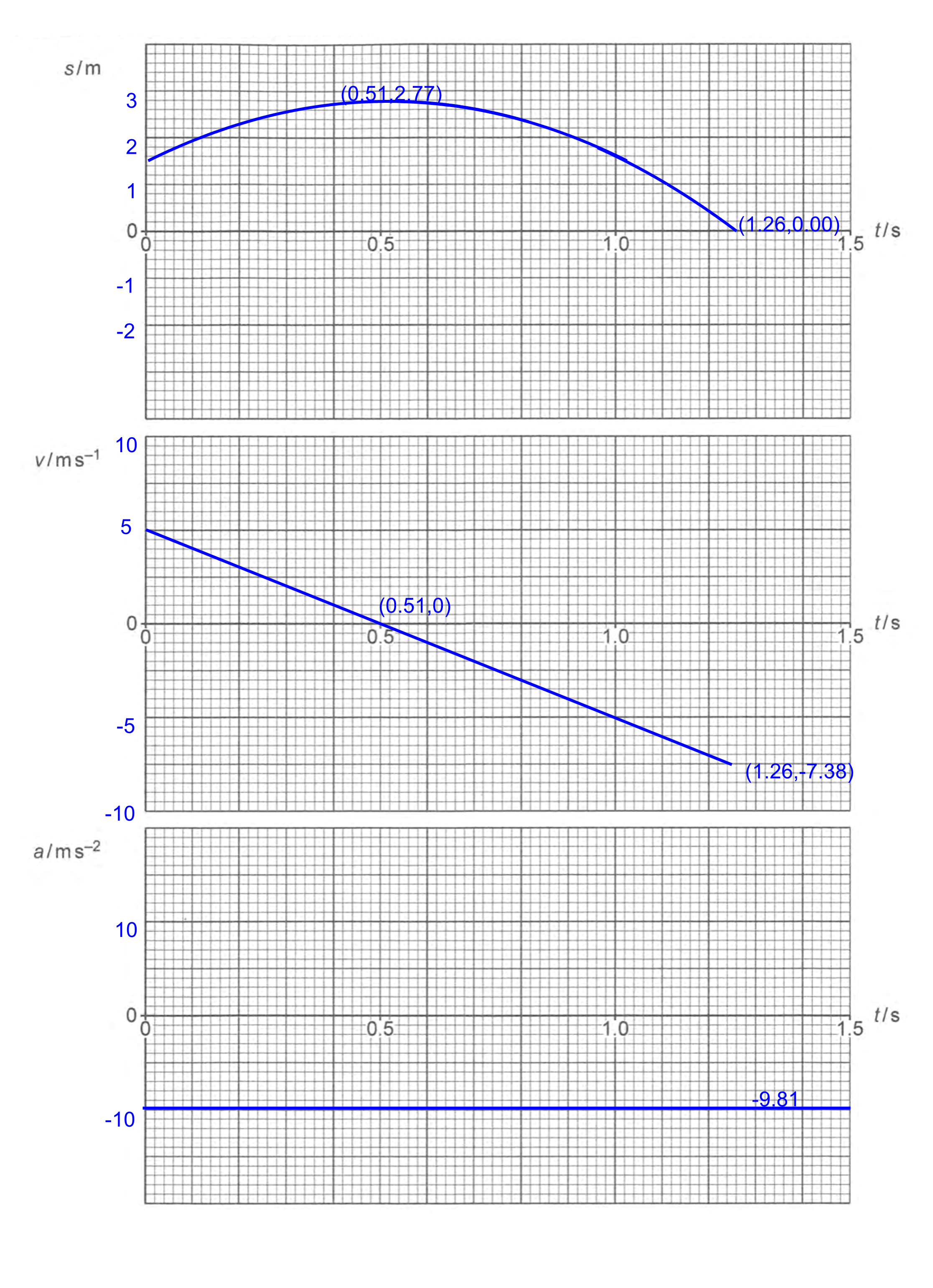
The speed is minimum at the top of the trajectory, when the speed is simply the horizontal component of velocity vx, because the vertical component of velocity is zero.

\displaystyle  \begin{aligned}   {{{KE}_{min }}} &=65 \\  \frac{1}{2}(0.55){{v}_{x}}^{2}&=65 \\  {{v}_{x}} &=15.37\text{ m }{{\text{s}}^{-1}} \end{aligned}

\displaystyle  v=\frac{{{v}_{x}}}{\cos 42{}^\circ }=\frac{15.37}{\cos 42{}^\circ }=20.69\text{ m }{{\text{s}}^{-1}}

\displaystyle  {{v}_{y}}=20.69\sin 42{}^\circ =14\text{ m }{{\text{s}}^{-1}}

COMMENT: For a “show” question, start with an explanatory sentence, and show all substitution values explicitly.

2b)

Time to reach peak, \displaystyle  {{t}_{p}}=\frac{{{u}_{y}}}{g}=\frac{14}{9.81}=1.427\text{ s}

Time of flight, \displaystyle  {{t}_{f}}=2{{t}_{p}}

Horizontal range, \displaystyle  R={{v}_{x}}{{t}_{f}}=(15.37)(2\times 1.427)=43.9\text{ m}

2c)

It takes shorter to reach its maximum height.

Air resistance acts in the same direction as gravity on the way up, but in opposite on the way down.

The object therefore decelerates at a faster rate on the way up than it accelerates on the way down.