20 B

For minimum resistance, the current should flow between the top and bottom surfaces, since this will incur the shortest L and largest A.
Author: mrchuakh
20 B
For minimum resistance, the current should flow between the top and bottom surfaces, since this will incur the shortest L and largest A.
14 C
At 

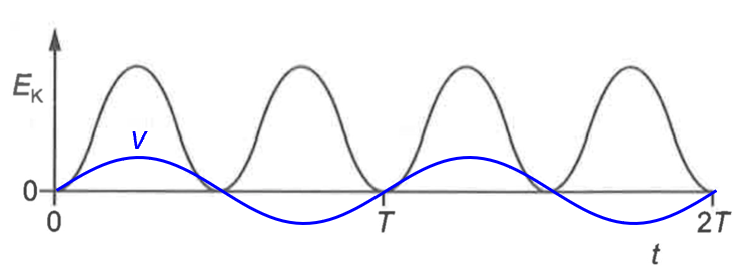
Each oscillation contains two complete energy cycles. So the EK graph must show two complete cycles during one T. (See below how the velocity-time graph is overlayed onto the EK graph)
19 C
The number density n must be the same since both wires are made of the material.
The drift velocity v must be higher in order to support the same current.
18 D
Two images may become indistinguishable due to the spreading of light when it passes through the aperture of optical instruments. Rayleigh criterion defines the condition when this becomes.
17 D
16 C
15 C
Option A: Undamped oscillation. (Amplitude is constant)
Option B: Damped oscillation. (Amplitude decreases over time)
Option C: Critical damping. (System returns to equilibrium position in the fastest time, without ever crossing the equilibrium position)
Option D: Nonsense. (System mysteriously remains forever displaced from equilibrium position)
13 D
Use m to denote the mass of volume V of water.
Method 1
Method 2
11 A
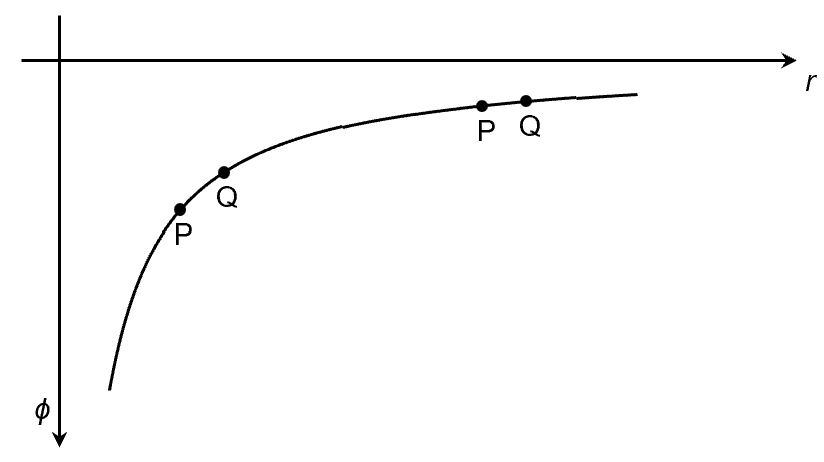


From the curvature of the graph, it is clear that the difference between the gravitational potentials of P and Q also decreases as they move towards infinity.
12 A
Time interval between collisions,
Change in momentum per collision,
Average force,


 xmPhysics