Author: mrchuakh

Standing Wave Harmonics

This video shows the standing waves that can be formed on a string fixed at both ends.

Since the string is fixed at both ends, any standing wave that forms on the string must have nodes at both ends.

The simplest standing wave that has nodes at both ends is the NAN. (Node-Antinode-Node) The next standing wave that can be formed is the NANAN, followed by

  1. NAN,
  2. NANAN,
  3. NANANAN,
  4. NANANANAN,
  5. NANANANANAN, and so on.

Notice that each NAN corresponds to one half-wavelength segment. This means

  1. NAN packs 1 half-wavelength along the length of the string,
  2. NANAN packs 2 half-wavelengths along the length of the string,
  3. NANANAN packs 3 half-wavelengths along the length of the string,
  4. NANANANAN packs 4 half-wavelengths along the length of the string,
  5. NANANANANAN packs 5 half-wavelengths along the length of the string, and so on.

Which means that

  1. NAN’s wavelength is called the fundamental wavelength,
  2. NANAN’s wavelength is 2x as short as that of NAN’s,
  3. NANANAN’s wavelength is 3x as short as that of NAN’s,
  4. NANANANAN’s wavelength is 4x as short as that of NAN’s,
  5. NANANANANAN’s wavelength is 5x as short as that of NAN’s, and so on.

Which means that

  1. NAN’s frequency is called the fundamental frequency, or 1st
  2. NANAN’s frequency is 2x that of NAN’s, hence called the 2nd harmonic,
  3. NANANAN’s frequency is 3x that of NAN’s, hence called the 3rd harmonic,
  4. NANANANAN’s frequency is 4x that of NAN’s, hence called the 4th harmonic,
  5. NANANANANAN’s frequency is 5x that of NAN’s, hence called the 5th harmonic, and so on.

Wave Reflection

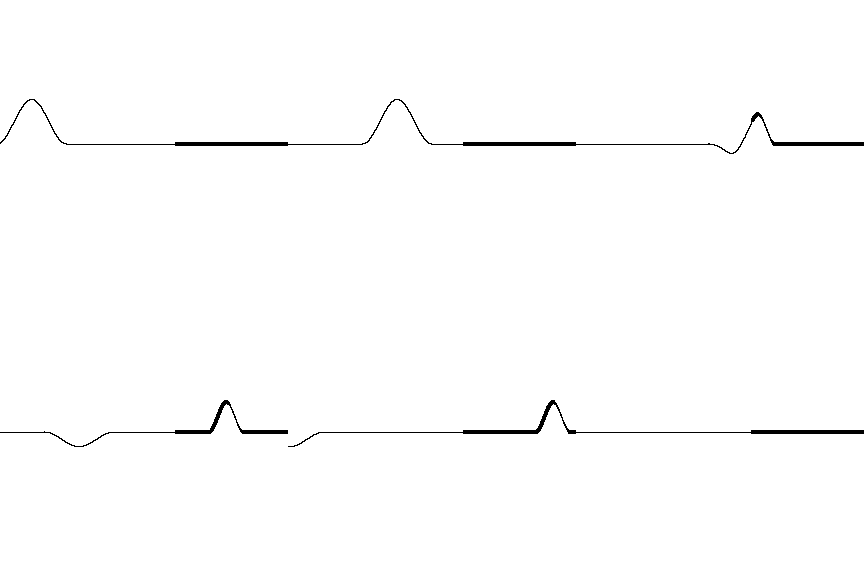
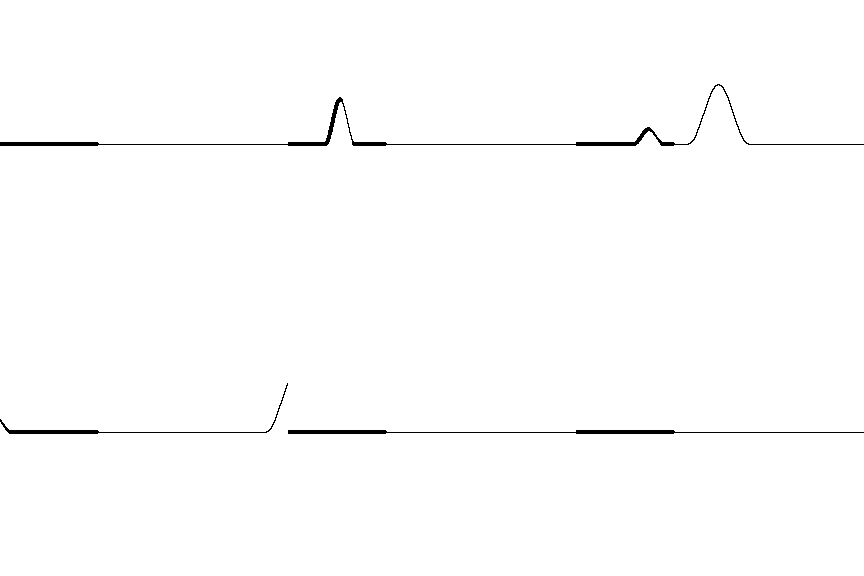
A wave always undergoes reflection when it hits the end of the road. If it is a hard reflection (like a fixed end), the reflection come with a 180° phase change (so the pulse returns on the other side of the slinky). If it is a soft reflection (like a loose end), the reflection comes with no phase change (so the pulse returns on the same side of the slinky).

(Beyond H2 syllabus)

Actually, when a wave encounters a discontinuity in the medium (aka medium boundary), only part of it is reflected, and the remaining part is transmitted. The fraction that is reflected depends on the degree of discontinuity. The more abrupt the change in medium, the higher the fraction that is reflected (and lower the fraction that is transmitted).

1 hard
2 soft

Compared to the slinky, the fixed end represents an infinitely heavy slinky, and the loose end represents an infinitely light slinky. For the wave traveling down the slinky, both the fixed end and the loose end represent the most drastic change in medium possible. That’s why 100% of the pulse was reflected and 0% was transmitted. If the medium change is not so abrupt, we will see some of the wave being reflected, and some being transmitted. As illustrated by the below.

3 reflect1
4 reflect2

Polarization by Reflection

When light passes from air to glass, some of it is refracted into the glass, and some of it is reflected. The reflected light is partially polarised because light polarised horizontally is reflected more strongly than light polarised vertically. In fact, at one particular angle of incidence called the Brewster’s angle, light polarised horizontally is 100% refracted, resulting in a 100% vertically polarised reflected light.

This phenomenon occurs for any transparent material, including glass, paint and water.

Further reading: http://en.wikipedia.org/wiki/Brewster%27s_angle

When Newton Meets Einstein

The picture of Newton was in green only, while the picture of Einstein was in red color only. Green and red light from the LCD projector are polarised perpendicularly with each other. As polarizer was rotated, it cut off either the green or the red so that only either Newton or Einstein comes into view.

Some 3D movies are made this way. The image meant for the left and right eyes are projected using two mutually perpendicular polarised light. The viewers are then given glasses which are fited with polarizers.

3dmovie.jpg

Polarised and Unpolarised Light

If light passing through ONE single polarizer shows variation in brightness as the polarizer is rotated, it must mean that the light is polarized.

As shown in the video, filament lamps, fluorescent lamps and the Sun emit light that is unpolarised.

The display screens of calculators, handphones and LED TV are all based on LCD (Liquid Crystal Display) technology, which produces polarized light.

9.4.2 Polarisation (Two Polarisers)

EM wave

A light wave has E-field oscillating at right angle to its direction of propagation. A polarizer allows only the component of E-field in the polarizer’s orientation to pass through.

Screen_Shot_2012-09-24_at_1.12.46_PM

So the first polarizer polarizes the unpolarized light. Because an unpolarized light has light in all orientations, its intensity always drops to half after passing through the first polarizer, regardless of how the polarizer is oriented.

If the second polarizer is oriented at the same angle as the first, then 100% of the polarized light is passed through. If the second polarizer is perpendicular to the first, then 0% of the polarized light is passed through. If the second polarizer is misaligned with the first by an angle θ, the amplitude of the polarized light will drop from E0 to E0cosθ, and the intensity will drop from I0 to I0cos2θ.

9.3.1 Transverse Vs Longitudinal

A transverse wave (the green one) is one in which the oscillations are perpendicular to the direction of wave propagation.

A longitudinal wave (the red one) is one in which the oscillations are parallel to the direction of wave propagation. It is interesting that a longitudinal wave sets up regions of compression and rarefaction. Notice also that the compression and rarefaction always occur at the point which is at its equilibrium position.

Rutherford’s Tissue Paper

In this analogy, Rutherford was emphasizing the surprising and unexpected observations of the alpha-scattering experiment: a massive and energetic particle (alpha particle) encountering something so dense and massive (the nucleus) that it could bounce back, much like a large shell coming back after being fired.