Tag: physics

5.3.1 Magnetic Cannon

Question:

Where did all the momentum come from? Is the PCOM violated?

Where did all the kinetic energy come from? Is the PCOE violated?

Answer:

PCOM
Notice that the other two balls recoiled to the right after the collision. (The recoil was at quite a high speed, but friction brought them to rest quickly) So even though the outgoing ball had a large leftward momentum, after subtracting the rightward momentum of the other two balls, the total momentum is still equal to the initial leftward momentum.

PCOE
Note that the magnetic field must have an associated magnetic potential. Since the field is attractive, the balls must be losing magnetic potential energy as they come closer. So even though the outgoing ball had a large kinetic energy, after accounting for the loss in magnetic potential energy, the total energy is still equal to the initial total energy.

Delving Deeper
Notice that after the demonstration, two balls were magnetically stuck to each other. Considerable effort must be expended to pull these two balls apart. Ths is the act that stores magnetic potential energy in the system.

So the demonstration actually started with the system full of magnetic potential energy. When the balls come closer, and become accelerated by the magnetic forces (resulting in a high-speed collision), the magnetic potential energy is being converted into KE.
3.1.1 Inertia Made Obvious in the International Space Station

On Earth, objects have a tendency to fall down and slow down, thanks to the ubiquitous forces of gravity and friction. As a result, the concept of inertia is obscured from unsuspecting earthlings.

Now watch this video of NASA astronauts living the “high life” in the International Space Station orbitting high above the Earth.

Question

See how many times you can see evidences of Newton’s 1st Law.

Answer

00:17
The luggages (and the lady) remain moving along a straight lines, until they are “forced” to change their directions.

00:34
The shaver remains at rest, hovering at mid air, unless it is “forced” to move.

01:26
The astronauts remain gliding through air at constant speed since there is no external forces to change their motion.

02:01
The food pieces (pizza slices?) remain in straight line motion at constant speed, until some external forces cause a change in their velocities. The orange ball, in particular, was seen travelling along a perfect straight line, until it bounces off the camera lens.

Shoot the Monkey

Question

The monkey falls off the tree the exact instant the shot is fired. So, to hit the falling monkey exactly, should you aim your shot exactly at the monkey, or slightly below? (Assume air resistance is negligible)

Answer:

You should aim exactly at the monkey (assuming air resistance is negligible).

Yes, the monkey is falling. But so is the bullet!

The key to understanding this puzzle is to realize that both the projectile motion of the bullet and the vertical fall of the monkey have the same exact acceleration (9.81 m s-2  downward).

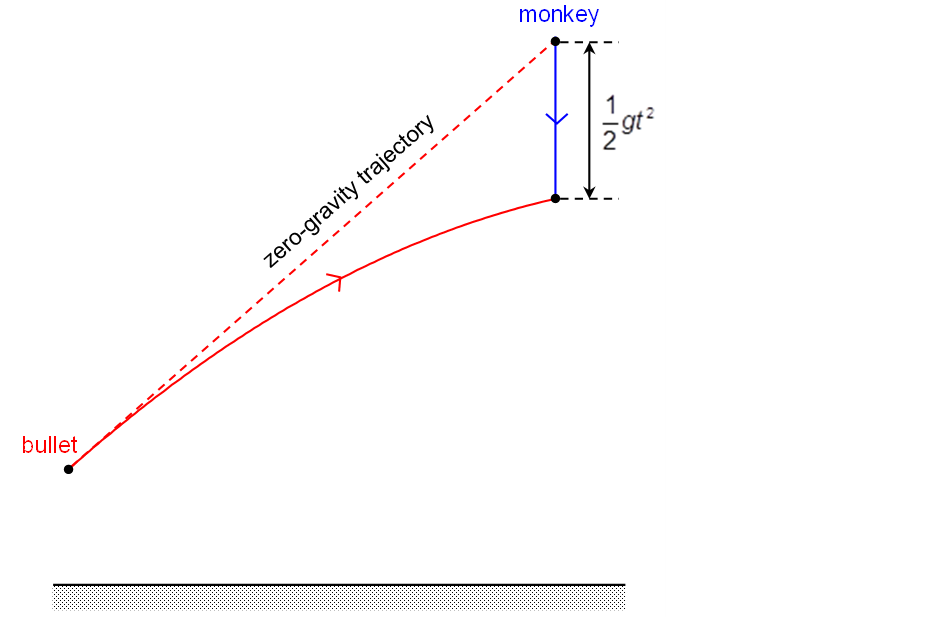
Let’s start off by pretending that there is no gravity. By aiming at the monkey directly, the bullet would have travelled along a straight line, and the monkey would have hovered in the air, resulting in a hit.

Now let’s switch gravity back on. The bullet would now travel in a parabolic path. At any time, the deviation from the zero-gravity-straight-line path is a vertical distance of 0.5gt2. What about the moneky? It would also have fallen down by a distance of 0.5gt2. Because gravity affected both motions equally, gravity or not, the monkey is doomed to be hit.

Flying Coins

Q: Which coin will land first?

Answer:

Notice that all six coins have the same exact vertical motion. This is because all of them have the same initial vertical velocity of zero (and the acceleration of 9.81 m s-2). Their horizontal motions however differ because they had different initial horizontal velocities.

Delving Deeper

Are you wondering why the horizontal spacing among the six coins look so evenly spaced out? Well, as the ruler swivels, different parts along the ruler travel at different speeds according to the formula v=. Because the coins were arranged evenly spaced out along the ruler, the ruler collided into them at speeds which are evenly spaced out. As a result, the (initial) momentum (and thus horizontal velocity) imparted to coins are also evenly spaced out.

The Sound of Projectile Motion

Q: What does a projectile motion sound like?

Answer:

The key to simplifying projectile motion is to separate the vertical motion
from its horizontal motion.

Horizontal Motion

A projectile motion has a constant horizontal velocity. Horizontally, the
ball moves forward at a constant speed. This is why equally spaced
“ting” sounds are made as the ball crosses the vertical lines.

Vertical Motion

Gravity acts vertically downward. Vertically, the ball slows down on the way
up, and speeds up on the way down (at a constant rate of 9.81 m s-2
downward). This is why the “ting” sounds become more and more spaced out on the
way up, and become closer and closer on the way down.

Bouncing Ball

Q: Does a bouncing ball experience constant acceleration?

Answer:

The answer is NO during the bounces, but YES in between bounces.

In between bounces, the ball is always having a downward acceleration of g=9.81 m s-2. As such, the displacement at equal time intervals display a square number sequence 0, 1, 4, 9, 16, 25… This makes sense since the s-t relationship is quadratic.

If we calculate the difference between each pair of square numbers (4-1, 9-4, 16-9, 25-16,…), we obtain the arithmetic progression 1, 3, 5, 7, 9… This shows that the distance travelled between equal time intervals increases at a constant rate. This makes sense since the v-t relationship is linear.

How many bodies do you see?

Q: Estimate the magnitude of the contact forces that the girls exert on one other.

Answer:

When applying Newton’s Laws (Fnet=ma), we have to decide what is going to be our body (m). Only then would  we know which forces to include (those that act on m) and which forces to exclude (those that do not act on m).

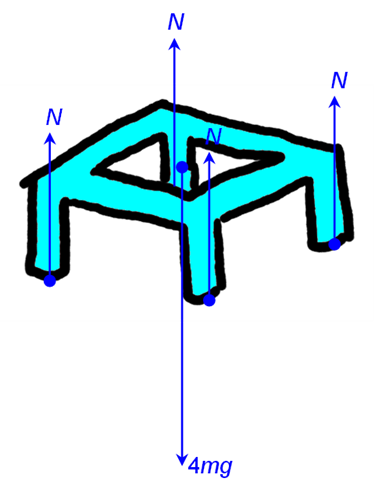
If we analyse all four girls as one combined body, then our free body diagram looks like this.

This allows us to quickly confirm that the magnitude of the normal contact force that the floor exerts on each girl is mg.

We can also analyse each girl as an individual body. Which leads us to following free body diagram.

Notice that Fu (upward contact force exerted by the next girl’s legs on this girl’s head) and Fd (downward contact force exerted by the previous girl’s head on this girl’s legs) did not feature in the earlier free body diagram. Why? Because as one combined body, these are internal forces.

Now, by considering the net moment about this girl’s foot (where N acts), we can estimate Fu to be about 0.5mg. Next, by considering the net force acting on this girl, Fd should also be about 0.5mg.

P.S. Yes, some assumptions have been made to simplify the analysis. I assumed that the girls have identical masses and dimensions. I also assumed that the C.G. is right at the middle. I also assumed Fu, Fd and N to be equidistant from the C.G.

Galileo’s Inclined Plane

Galileo may not be as famous as Newton or Einstein. But he is widely acknowledged as the father of modern science. This is because he was the first to subject his theories to experimental observations. Basically he pioneered the scientific method.

For example, instead of arguing philosophically over whether objects of different masses should fall at the same rate, he conducted experiments to observe whether they actually fall at the same rate.

But it was not easy to conduct such experiments. Falling objects accelerate too quickly. And Galileo did not have stopwatches nor slow-motion videos to work with. But he had a brilliant idea. Why not measure the rate at which balls roll down inclines instead? The incline will “dilute” gravity, and make the motion slower and more easily measurable!

As you watch this video, ask yourself

Q: How can we tell that the golf ball is moving at constant acceleration?

A: The markings show that the distances it travels (between equal time intervals) increases at a constant rate. This means that its velocity increases at a constant rate, implying constant acceleration.