Tag: projectile motion

Shoot the Monkey

Question

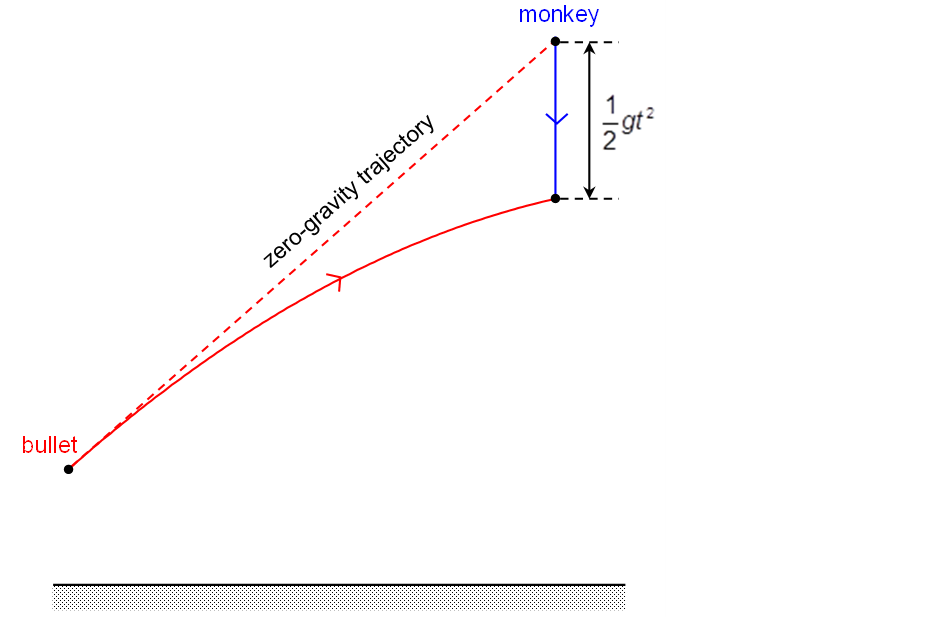
The monkey falls off the tree the exact instant the shot is fired. So, to hit the falling monkey exactly, should you aim your shot exactly at the monkey, or slightly below? (Assume air resistance is negligible)

Answer:

You should aim exactly at the monkey (assuming air resistance is negligible).

Yes, the monkey is falling. But so is the bullet!

The key to understanding this puzzle is to realize that both the projectile motion of the bullet and the vertical fall of the monkey have the same exact acceleration (9.81 m s-2  downward).

Let’s start off by pretending that there is no gravity. By aiming at the monkey directly, the bullet would have travelled along a straight line, and the monkey would have hovered in the air, resulting in a hit.

Now let’s switch gravity back on. The bullet would now travel in a parabolic path. At any time, the deviation from the zero-gravity-straight-line path is a vertical distance of 0.5gt2. What about the moneky? It would also have fallen down by a distance of 0.5gt2. Because gravity affected both motions equally, gravity or not, the monkey is doomed to be hit.
Flying Coins

Q: Which coin will land first?

Answer:

Notice that all six coins have the same exact vertical motion. This is because all of them have the same initial vertical velocity of zero (and the acceleration of 9.81 m s-2). Their horizontal motions however differ because they had different initial horizontal velocities.

Delving Deeper

Are you wondering why the horizontal spacing among the six coins look so evenly spaced out? Well, as the ruler swivels, different parts along the ruler travel at different speeds according to the formula v=. Because the coins were arranged evenly spaced out along the ruler, the ruler collided into them at speeds which are evenly spaced out. As a result, the (initial) momentum (and thus horizontal velocity) imparted to coins are also evenly spaced out.

The Sound of Projectile Motion

Q: What does a projectile motion sound like?

Answer:

The key to simplifying projectile motion is to separate the vertical motion
from its horizontal motion.

Horizontal Motion

A projectile motion has a constant horizontal velocity. Horizontally, the
ball moves forward at a constant speed. This is why equally spaced
“ting” sounds are made as the ball crosses the vertical lines.

Vertical Motion

Gravity acts vertically downward. Vertically, the ball slows down on the way
up, and speeds up on the way down (at a constant rate of 9.81 m s-2
downward). This is why the “ting” sounds become more and more spaced out on the
way up, and become closer and closer on the way down.