An electric charge in an electric field always experiences an electric force. A charge in a magnetic field, however, does not necessarily experience a magnetic force.
Stationary Charge

Just like a wire carrying zero current experiences no magnetic force, a stationary charge does not experience any magnetic force. This is because 

v parallel to B
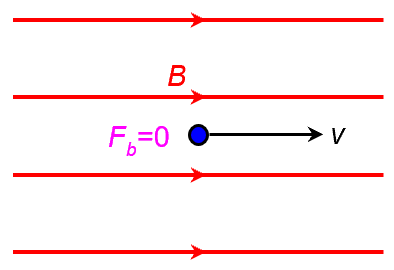
Just like a current carrying conductor placed parallel to a magnetic field experiences no magnetic force, a charge moving parallel to the direction of B does not experience any magnetic force. This is because 

v perpendicular to B
A charge moving perpendicular to the direction of B, however, does experience the magnetic force 

For a particle of mass m and charge q, we have

To find T, the time taken for one complete revolution, we can divide the distance by speed:

Two interesting results:
- For the same v and B, the radius of circular motion is directly proportional to
, the mass to charge ratio. This relationship is the basis for mass spectroscopy.
- The time taken for a charged particle to complete one revolution is independent of its speed. This result is exploited in the design of particle accelerators called cyclotrons.
–
[1] This is not so for the electrons drifting in a current-carrying conductor because they are constrained by the metallic bonds to drift inside the wire.
 xmPhysics